
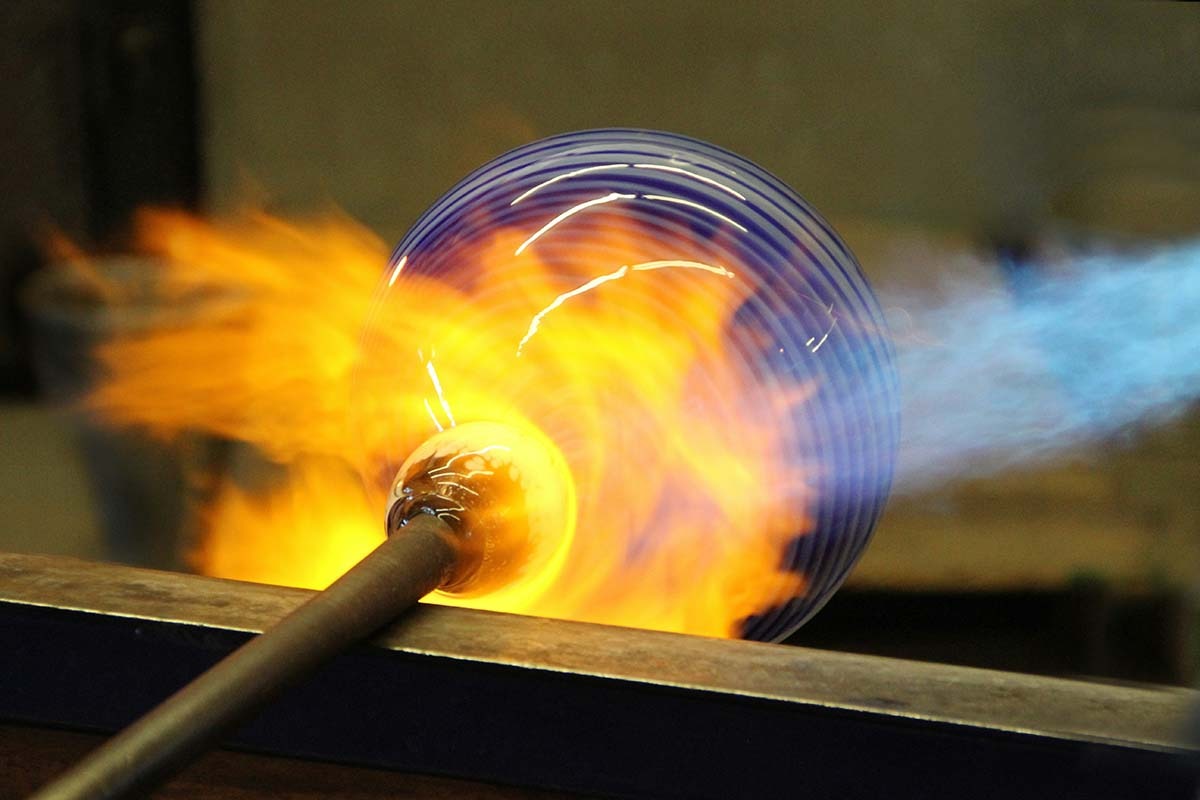
ELQAVA was founded on a single conviction: that the world's most interesting objects are made by hand, in small numbers, by people who have spent a lifetime learning to make one specific thing.
The name ELQAVA comes from a word meaning to gather, to collect, to bring together from disparate sources. It was chosen deliberately — not as a brand name in the conventional sense, but as a statement of purpose. We do not manufacture. We gather.
The first journey that led to ELQAVA was to the island of Murano, off the coast of Venice, where glass has been made since 1291. The Venetian Republic relocated its glassblowers there — partly to reduce the fire risk to Venice, partly to control the secrets of their trade. Those secrets have been passed down through families and workshops for seven centuries.
What we found in Murano were artisans who had mastered a discipline that modern manufacturing has rendered largely unnecessary. They were making extraordinary objects — and very few people were finding them. ELQAVA was built to solve that problem.
“The mould is carved in steel; the colour is layered by eye and instinct. No machine, no duplication.”
Murano glass is not simply a material. It is a living tradition — one that has survived the industrial revolution, two world wars, and the globalisation of manufacturing precisely because it cannot be industrialised. The technique of mouth blowing — gathering molten glass on a blowpipe and shaping it with a single sustained breath — requires a physical understanding that cannot be mechanised or digitally replicated.
The result is an object with a quality of presence that machine-made objects lack. When you place an ELQAVA piece in a room, you are placing something that was once a single breath. That sounds like marketing language; it is actually physics. Every form in our collection began with a human exhalation.
We have also selected pieces from Poland — specifically, a single workshop in Warsaw that has developed a glass tradition descended from Murano techniques but with its own aesthetic sensibility: starker, more geometric, more influenced by Central European modernism. The Seal of Serenity is from this workshop. You will notice the difference immediately.
Every piece in the ELQAVA collection has passed three criteria. First, it must possess what we call stopping quality — the ability to halt a person entering a room and direct their gaze. This is partly objective (scale, colour intensity) and partly entirely subjective: some pieces simply stop people and others do not.
Second, every piece must be strictly limited. We do not work with manufacturers who produce editions of hundreds. Our maximum edition size is five. The majority of pieces are in editions of two or three. Several are last pieces — they will not be made again when they sell.
Third, every piece must ship safely worldwide. This sounds logistical, but it is also a commitment: when you buy an ELQAVA piece from India, from the United States, from Singapore, it will arrive precisely as it left Murano. We have developed our packaging specifically for this purpose.
“Some pieces simply stop people and others do not. We have tried, over many journeys, to understand why. We have not entirely succeeded. We have simply learned to recognise it.”
There is a contemporary tendency to distrust beautiful objects — to feel that investing in something for its beauty alone is somehow indulgent or wasteful. We disagree, and we think this view misunderstands what beautiful objects do in a life.
An ELQAVA piece placed in a home changes the experience of that home. Not in a large, dramatic way — not like a renovation — but in the way that light changes a room, or music changes a silence. The Helix of Light on a table, with a candle burning through its twisted orange-and-green glass, makes the table different. It makes the room different. It makes the evening different.
We believe this is worth paying for. Not at the expense of more pressing needs, obviously. But as an investment in the quality of daily experience — in what you see and feel when you sit in your own home — it is one of the most direct investments available.
We limit our editions to preserve rarity — not to create artificial scarcity for marketing purposes, but because the artisans we work with genuinely cannot produce more. We price fairly relative to this scarcity, not relative to what the market might theoretically bear.
The name on the label matters less to us than the name of the workshop. We are a curator, not a manufacturer. Our value is in finding and selecting — not in the brand equity of ELQAVA itself, which is deliberately understated. The piece should speak, not the box it came in.
We do not follow seasonal collections or trend cycles. The pieces we select are chosen because they will look as right in twenty years as they do today. Glass, in particular, ages well — it does not degrade, does not go out of style, does not require maintenance. It simply continues to catch the light.
The constraints we work within are not limitations — they are the source of the work's value. A collection of 43 pieces, each in an edition of one to five, is the right size for what we are doing.
Browse the full collection by category. Every piece you see is available now, in the quantity shown. When they sell, they are gone.